Can’t seem to keep your hair looking great despite all the care you give it? Perhaps you’ve overlooked a crucial element when choosing your products: porosity. Discover everything you need to know about it to concoct your ideal hair care routine!
What is hair porosity?
Porosity refers to your hair’s ability to absorb and retain moisture. All hair is naturally permeable, but the degree of porosity varies from person to person: you may have low, medium, or high porosity hair. The specific thing about high-porosity hair is that it drinks up moisture but cannot retain it. Imagine a sponge that you soak with water and then place in the oven: within minutes, all the water has evaporated and the sponge is ultra-dry again. It’s the exact same principle! Conversely, low-porosity hair struggles to absorb moisturizing treatments. Ideally, as you might suspect, you want medium porosity: the hair is then considered "normal."
What happens in high-porosity hair?
To better understand this porosity phenomenon, let’s take a look at the hair structure! The core of your hair is coated in a protective layer made of tiny scales: this is called the "cuticle." It is thanks to this type of armor that it manages to protect itself and stay perfectly healthy. On healthy hair, these scales overlap like shingles on a roof: they provide enough of a barrier against external damage without preventing the hair from breathing and receiving a sufficient dose of moisture. But sometimes these scales crumble and lift: the inside of the hair is no longer properly protected from dehydration, and that is when we speak of high-porosity hair. On low-porosity hair, however, these scales are packed too tightly against each other... so much so that they let almost nothing through, not even your hair treatments!
Where does this porosity come from?
Beyond hair aging (during which the cuticle degrades), there is a genetic factor to consider in this porosity. Some are born with porous hair, others with hair that isn't porous enough... In short, it’s a bit of a lottery! Kinky hair is generally less porous than Caucasian hair, unless it has been subjected to poor treatment... Indeed, more often than not, hair becomes porous due to events that have traumatized its cuticle: overuse of styling accessories (brushes), heat tools (hair dryers, straighteners), chemical treatments (coloring, relaxing), or even sulfate shampoos, which are well-known for stripping the hair's surface.
How do I know if I have porous hair?
Recognizing high-porosity hair
- When you wet your hair, it soaks up water quickly. • It dries very fast after shampooing. • It looks frizzy, dull, and rough after drying. • It tends to get tangled. • Moisturizing treatments seem ineffective.
Recognizing low-porosity hair
- Your hair has trouble soaking up water when washing. • It takes a very long time to air-dry. • It looks rather healthy and shiny. • When you color your hair, the color doesn't hold. • Moisturizing treatments cannot penetrate and remain on the surface.
The water glass test
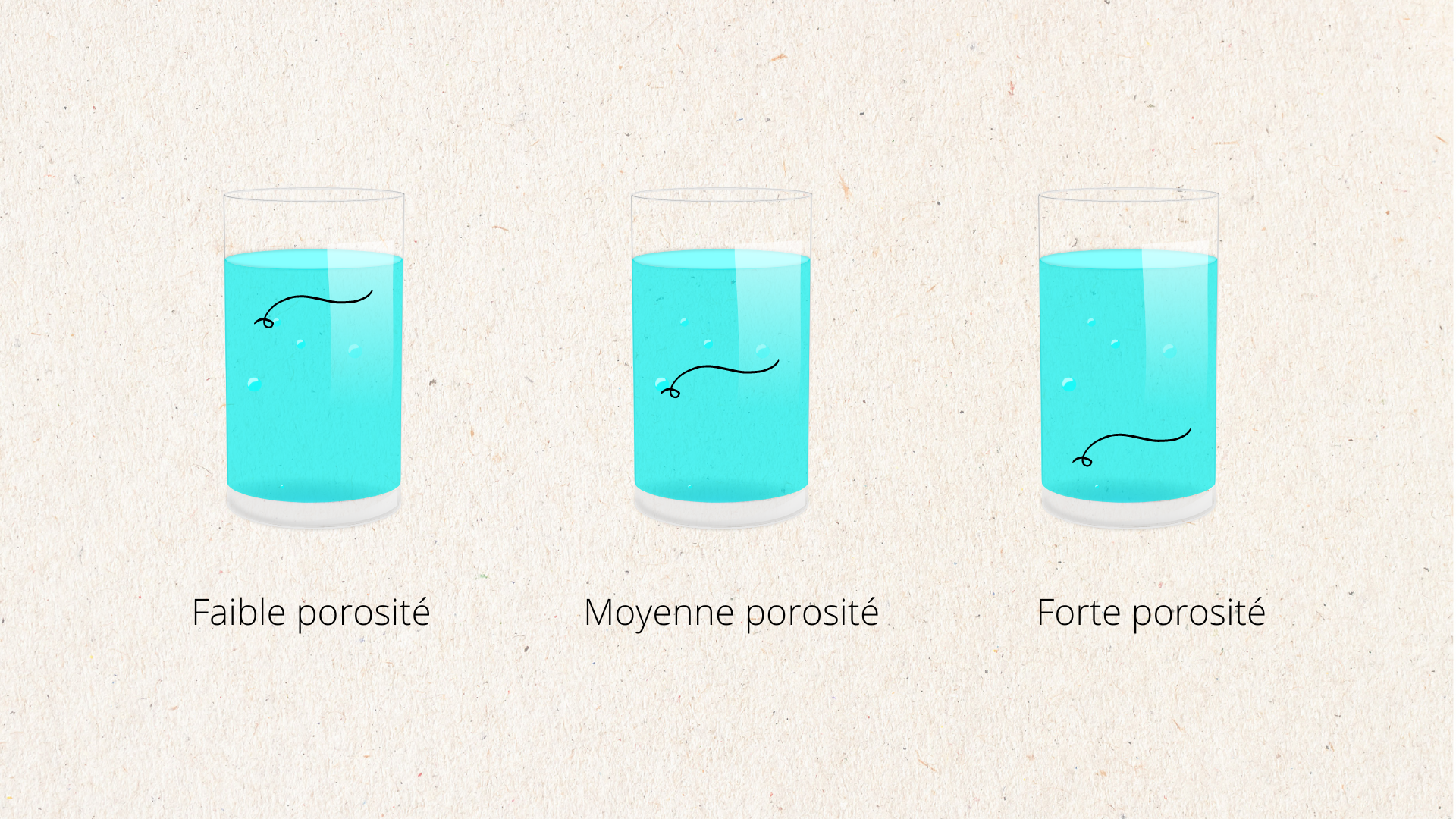
Still can't identify your porosity? Don't panic, we have a little test for you! After washing and air-drying your hair, take one of your hairs from your brush or directly from your scalp. Ensure you have not applied any product before doing this test: this could skew the results. Place the hair in a glass filled with lukewarm water and wait 2 to 5 minutes. • Your hair has sunk to the bottom of the glass: you have high-porosity hair. • Your hair is submerged halfway in the glass: you have medium-porosity hair. • Your hair is floating on the water: you have low-porosity hair.
How do I adapt my hair routine to my porosity?
To properly hydrate your hair, it is crucial to know its porosity level. Low-porosity hair does not have the same needs as high-porosity hair at all! If you don’t take this information into account for your routine, you risk seeing no results in the quality of your hair, or even worsening its condition. It is even more important to follow this rule with kinky hair, which is naturally dry.
My routine for high-porosity hair
Incorporate acidic pH (< 7) treatments into your routine: they help close the cuticle scales. Also, load up on proteins, which will help strengthen keratin and fill the gaps that are too wide between the scales. Finally, remember to use fatty substances to coat the hair fiber and minimize dehydration as much as possible: opt for butters and heavy vegetable oils (e.g., coconut, castor). Always finish with a rinse of cold water or apple cider vinegar. Your daily shampoo: Hibiscus shampoo bar. Your deep treatment: coconut-spirulina hair mask. Your leave-in: the coconut oil hair milk + coconut oil melting balm duo.
My routine for low-porosity hair
Choose hair cosmetics with a basic pH (> 7). To optimize the penetration of your treatments, don't hesitate to use a heating cap: the heat encourages the scales to open. Avoid proteins and products that are too heavy (especially those based on coconut), which could suffocate your hair. Turn instead to light, hydrating leave-ins to restore body to your curls! Your daily shampoo: Bay Saint Thomas shampoo. Your deep treatment: the hibiscus cream + cap duo. Your leave-in: the hibiscus hair milk.