Blog
Coily, curly, wavy or frizzy hair? This blog is for you!
Discover our best tips, routines and natural secrets to pamper your texture, boost your volume and love your hair every day.
Blog

Mango butter: where does it come from?
Mango butter: where does it come from? The mango tree is a tree native to India and Burma, which can reach up to 40 meters in height. Today, it is grown in all tropical countries, mainly for its fleshy fruits. The juicy and fruity flesh of mangoes is highly appreciated for its pleasant sweet taste and its high energy content (it is particularly rich in vitamin C). At the heart of the mango is a flat pit containing a seed (or kernel) which, once pressed, produces a butter much less well-known than the rest of the fruit. Yet this butter provides an unparalleled texture. Rich in isostearic acid, it is the ideal ingredient for your hair care: a true ally for damaged hair, Mango butter provides a coating action to the scales, shine to the hair and helps prevent the formation of split ends. The properties of mango butter It is particularly rich in fatty acids but also in sterols and polyphenols, which give it antioxidant as well as emollient and protective properties. Mango butter is softening and leaves the hair supple. By strengthening the hair cuticle, it provides radiance and shine. Nourishing and emollient, it repairs and softens the hair fiber and maintains hydration. Finally, it prevents the formation of split ends.
Learn more
The 3 golden rules for protecting your afro-textured hair in winter
Winter is coming! Between the dry, heated air indoors and the icy gusts outdoors, your hair is going to be put to the test. Rest assured: having hair full of pep even in winter is possible... provided you adapt your hair routine and follow a few golden rules. 1. Hydrate, hydrate, and… hydrate some more! This is undoubtedly the best advice we can give you to face winter with peace of mind. The hair fiber needs regular hydration to stay healthy. This is even more true for Afro hair, which is naturally drier. In cold weather, you must be extra vigilant: if you don’t provide your hair with enough moisture, it risks drying out even further, generating static electricity, and even breaking! To avoid disaster, make sure to apply a moisturizing product daily to your strands. If you have high-porosity hair, try the LOC method (Liquid / Oil / Cream) once a week. The oil helps seal in moisture, and the cream closes the cuticle to form a shield on the surface of the hair. We also recommend wearing protective hairstyles, such as twists, box braids, or cornrows. Our favorite? The hibiscus hair milk, which works wonders on kinky hair in winter—ideal for low-porosity hair. Remember to apply it well every day and distribute it from bottom to top so that your ends, which are more fragile, can benefit from it as much as possible. 2. Focus on deep conditioning To maintain the beauty of your curls during the cold season, increase the frequency of your deep conditioning treatments to once a week. They allow you to boost hydration and nutrition but, above all, to restore the hair fiber damaged by the harsh weather. If you pamper them regularly with masks adapted to their nature, your hair will be better armed to face the winter. Take this opportunity to manage their protein intake as well. The balance between hydration and protein plays a crucial role in maintaining your hair: this is because the hair fiber is composed largely of keratin, a very resistant protein that helps your hair deal with external aggressions. If you find your coils are less bouncy and feel limp, it means a protein treatment is necessary! At Kalia Nature, we can no longer live without the coconut-spirulina hair mask, because it manages both hydration and protein. A little all-in-one genius, with no unnecessary ingredients, which honors coconut and the queen of blue algae: spirulina, which will make all the difference to the health of your curls. Plus, its ultra-creamy, cocooning texture is so comforting that we keep coming back for more... 3. Prevent hair loss Have you noticed more hair than usual on your brush? Don’t panic: losing your hair is completely normal. To give you an idea, know that 20 to 100 of your hairs (out of about 150,000, after all!) fall out naturally every day. This simply means they have reached the end of their life and it is time for them to make room for new ones. However, in winter, hair loss tends to increase. Why? Simply because the winter season is a trial for your lovely mane... and your body in general. It’s cold, you’re tired, you’re more prone to deficiencies: these are all internal imbalances that directly affect hair health. Therefore, it’s no surprise that more of them are dying off... To curb the phenomenon and show off a full head of hair, don’t hesitate to do a vitamin cure. For even more obvious results, you can also stimulate your scalp directly. The murumuru serum is perfect for this: it contains murumuru butter, an Amazonian fruit that is overflowing with vitamins and fatty acids. Take the time to massage (we said massage, not rub!) your roots; this will oxygenate the bulbs and help your hair regenerate faster. My nappy hair in winter? No problem! Thanks to these golden rules, you will no longer worry about your Afro hair in winter. Get ready for snowball fights with your kids and magical excursions with your hair blowing in the wind under the snowflakes! We have three final tips: space out your washes, avoid wool or synthetic hats, and make sure your hair is completely dry before stepping outside. And, finally, enjoy this beautiful season!
Learn more
Essential Oils: From Superheroes to Supervillains
Essential oils are the queens of natural cosmetics and the healthy trend. We love them on our faces, on our bodies, and (obviously) on our hair. To get the best out of them without any nasty surprises, use them according to the rules of the art: with caution and consideration. The Kalia Nature team explains it all! What exactly is an essential oil? Did you know that essential oils… are not really oils? Unlike vegetable oils, these are not fatty substances, but rather volatile substances. They are extracted from flowers, leaves, fruits, seeds, roots, or even bark through distillation. It takes a huge amount of raw material to create a few drops of essential oil. That is why they are so precious. For example, the production of 1 L of neroli essential oil requires… 1 ton of flowers (wow!) Why are essential oils so effective? Essential oils have been widely used since Antiquity. Today, they are used cutaneously, orally, and by inhalation. If they have been acclaimed for millennia, it is because they have the unique ability to concentrate the noblest part of aromatic plants. Their chemical formula is, moreover, very complex. An essential oil can be composed of more than 200 different molecules! It is all these components which, taken individually or in synergy, give it super-powerful cosmetic and therapeutic properties. What do essential oils do? This richness in active molecules is an essential oil's calling card. Depending on its content, it can have a very specific action: soothing, rebalancing, anti-wrinkle, detoxifying, etc. Some have such a complete composition that they are even versatile! Good to know: when applied to the skin, all essential oils have the ability to stimulate the renewal of your skin cells. Pretty cool, right? But it doesn't stop there! Essential oils have a kind of superpower. When applied externally, they are able to migrate directly to the weakened area that needs them most. A bit like two magnets attracting each other! This is called electivity. Essential oils: are they dangerous? Beware of overgeneralizations! Just because essential oils are natural does not mean they are safe. They are, in reality, so concentrated in active ingredients that they can present a risk of toxicity in high doses. In short, they are your friends… provided you avoid excess. Indeed, they are among the rare natural substances to be absorbed at lightning speed and to penetrate the layers of the skin deeply. They even manage to pass into the blood. In normal times, this "privilege" is reserved for medicines… not cosmetics. So yes, this is what makes them so effective. But it is also the reason why you have every interest in not handling them lightly! In what cases are essential oils not recommended? Are you pregnant or breastfeeding your baby? Then forget about essential oils, both for external and internal use. Do not use essential oils on your children if they are under 3 years old. Some remain strictly contraindicated for little ones under 6 years old (eucalyptus globulus, sage, peppermint, etc.). Check with a professional before attempting anything! If you suffer from a neurological disease (epilepsy or other), you must absolutely ask your doctor for advice before integrating essential oils into your routine. What are the usage precautions to know? Never apply a pure essential oil to your skin. You risk ending up with irritation. You must always dilute it in a vegetable oil (jojoba, avocado, argan, etc.). Some essential oils are photosensitizing, meaning they make your skin vulnerable to the sun. This is often the case for citrus essential oils (lemon, grapefruit, bergamot). Avoid exposing yourself to the sun for 12 hours after their application. The majority of essential oils contain allergens (linalool, citral, geraniol, etc.). The trick to spotting them: they are listed at the very end of your cosmetics' INCI declaration. Always perform a tolerance test before using a new product containing an essential oil. Apply a small amount to the inside of your elbow. If your skin hasn't reacted after 24 hours, you have the green light! Kalia Nature's recommendations Do It Yourself (DIY) is on the rise. It must be said that it is very nice to make your own cosmetics, cleaning products, and everything else. We support the initiative, which helps with recycling and fighting against overconsumption. However, we advise the utmost caution, especially for products intended to come into contact with your skin. The recipes you find on the Internet are not all written by cosmetologists (far from it…). When deciding to incorporate essential oils into a formula, there are very specific conditions to respect, particularly in terms of concentration. At Kalia Nature, we scrupulously measure all the essential oils we add to your hair care products. Our goal: to ensure both their safety and their effectiveness for the beauty of your hair. Our favorite essential oils for hair We are aware of the incredible properties of essential oils. And it would be a real shame to deny yourself them! We have selected some of the best of them to take care of your hair. Grapefruit: strengthens hair and prevents hair loss. Bay Saint Thomas: encourages hair growth and helps eliminate dandruff. Cinnamon: stimulates blood circulation and strengthens the hair fiber. Lavender: regulates excess sebum and soothes skin irritation. Ravintsara: tones and relieves scalp discomfort. Ylang-Ylang: provides shine and invigorates limp hair. Find essential oils in your Kalia Nature products! Good news: these little bombs of benefits are already present in some of your Kalia Nature care products! You will generally find them in our products intended to be applied to your scalp. (Because yes, that is where you need to act to promote healthy growth.) Stinging Nettle Shampoo Bay Saint Thomas Shampoo Stinging Nettle Solid Shampoo Coconut Oil Hair Milk Gourmet Coconut Oil Balm Murumuru Serum Prefer to avoid essential oils? Head over to our Hibiscus range!
Learn more
Bantu Knots!
The Bantu knot is a hairstyling technique that consists of twisting and wrapping sections of hair around themselves and then securing them against the scalp to form small buns (Bantu knots). Once the buns are undone, you naturally get beautiful curls. Bantu knots (also known as Mattôbôh in Cameroon and Kaka kabri or ti-choux in the West Indies) are a traditional hairstyle of the Bantu people. Bantu women wore this simple yet aesthetic hairstyle for various occasions or traditional ceremonies. Today, this hairstyle has become very trendy: many women, as well as personalities, celebrities, and models, wear Bantu knots with pride and elegance. Step 1: Wash, hydrate, detangle Before starting, make sure your scalp is clean. Your scalp will be exposed, and the buildup of styling products would promote itching and the accumulation of ambient dust in your hair. After shampooing, remember to apply a moisturizing conditioner that will help protect and better manage the hair during the detangling phase. Ideally, apply a leave-in conditioner to nourish the lengths. You can finish your routine with our hibiscus melting balm, which will best seal moisture into your hair. Step 2: Execution Take a section of hair, wrap it and twist it around itself, then secure the resulting bun with an elastic band. Repeat this process all over your head. The tighter your buns, the tighter your curls will be with a nice spring. Making larger buns will take less time, but the resulting curls will not last as long. Step 3: The Knot Out! It's time for the reveal! Remove the elastic holding the bun, gently separate your hair with your fingers to let the curls fall. Once all the buns are undone, run your fingers through your hair to stretch your curls, add volume to your hair, and blur any separations between the sections.
Learn more
Sapote oil
Generally used to stimulate hair growth, this oil is an exceptional ingredient for the care of dry hair. It is also known for soothing even the most sensitive scalps. It is known to curb hair loss, soothe the scalp, nourish and detangle, and provide shine and a soft touch. Where does sapote oil come from? Traditionally used in Santo Domingo to stimulate hair growth, sapote vegetable oil is a choice ingredient for the care of textured hair. Its subtle almond scent will beautifully fragrance your hair. The "true" sapote is the fruit of the Pouteria sapota, which grows only in Central America and the Caribbean. Belonging to the Sapotaceae family, it is a large fruit, about fifteen centimeters long, round or oval, and can weigh up to 2 kg. Its pinkish-orange flesh contains 1 to 4 seeds that are rich and have the sweet scent of bitter almond. Sapote oil is extracted by first cold mechanical pressing of the seeds. The main constituents of sapote oil Sapote oil is a truly precious oil. Rich in vitamins (A, C, calcium, potassium, iron, carbohydrates), vegetable proteins, omega-6 (linoleic acid), omega-9 (oleic acid), and saturated fatty acids (stearic acid, palmitic acid), it is clearly an ally for textured hair. Like coconut oil, sapote oil may solidify. Simply melt it in a bain-marie to return it to a liquid texture. The properties of sapote oil This oil stimulates hair growth, slows down hair loss, nourishes and detangles, soothes the scalp, and adds shine and a soft touch to the hair. Finally, it helps regenerate dry and brittle hair. Find all the benefits of sapote in our sapote conditioner.
Learn more
Coconut oil, discover its benefits!
Where does coconut oil come from? Belonging to the Arecaceae family, the coconut produces an oil rich in essential nutrients. It originates from certain tropical regions, notably Polynesia and Southeast Asia. Today, it grows naturally in most countries with a tropical climate. This quintessential exotic fruit grows on coconut palms. Coconut oil is therefore naturally extracted from the coconut through pressing, without the addition of any other ingredients. The benefits of coconut oil Cold extraction of the oil preserves all the nutrients of the coconut without altering their quality. Vitamins, minerals... Its components give it extraordinary properties. Coconut oil nourishes and strengthens the hair. Lauric acid, a fatty acid with a light molecular structure that has a high affinity for hair proteins, penetrates the scalp easily and nourishes the hair fiber, giving it shine and strength. Furthermore, its film-forming effect acts as a protective veil on the surface of the hair, thereby limiting dehydration and helping to smother lice. It is also an excellent anti-dandruff treatment. Common misconceptions about coconut oil Oils are generally used to moisturize hair, yet when hair is dry, it is thirsty and needs to drink. In reality, oil and water do not mix. Oil repels water: it either pushes water out of the hair or prevents water from entering it. In short, the oil will not penetrate the hair to repair it, but will instead form a barrier between the hair and what it needs. Coconut oil is therefore suitable for porous hair with open cuticles, as the oil can penetrate quickly, unlike low-porosity hair, which will struggle to absorb hydration. And at Kalia Nature? We have 3 products based on coconut oil: The coconut-spirulina mask, the coconut oil hair milk, and the coconut oil gourmet balm.
Learn more
4 ultra-simple eco-friendly tips for your Kalia Nature bottles!
1. Recycle your empty containers If you have been a long-time user of our products, you have no doubt noticed a small change in our packaging at the beginning of 2019: we moved away from our colored PET plastic bottles and opted for crystal PET. Perhaps you are one of those who wondered why, and that is perfectly normal! So, we agree: colored PET is very pretty and adds some pep to your bathroom. The only thing that bothers us is that it is much more difficult to recycle than transparent plastic. This is due to the dyes added to the polymer, which complicate the transformation process. Crystal PET, on the other hand, poses no problem and is 100% recyclable! Once your Kalia Nature bottle is empty, you can now throw it freely into the yellow bin (the one reserved for recyclable packaging) or follow your local council's guidelines. Remember to peel off the label beforehand: it is not recyclable and goes straight to the trash. Thanks to your action, the sorting center will be able to reuse the plastic to produce a new object. And that is great! 2. Give your bottles a second life Are you a fan of DIY? This tip is for you! Instead of throwing away your empty bottles, you can also reuse them. This option has a double advantage: not only does it reduce your waste, but it also allows you to exercise your creativity to create original objects that you won't find anywhere else. You are free to personalize your empty Kalia Nature containers in many ways: paint, fabric, stickers, rhinestones, stencils, lace... There is no limit to customization! Don't hesitate to involve your children in this manual activity: it develops their artistic spirit and helps them learn while having fun. There is no doubt they will find lots of ideas! And if you are short on inspiration, here are some suggestions from the Kalia Nature team to create unique and practical decorations, alone or with your family: Use a large Hibiscus Cream jar to plant a succulent. Turn a weighted shampoo bottle into a single-flower vase. To stop losing your hair ties and pins, keep them safe in a Melting Balm jar. For your desk, recycle a Styling Gel container into a little catch-all pot to store the staples and paperclips that tend to wander off, etc. 3. Opt for hair milks without the pump Are you a fan of our hair milks to hydrate and protect your mane? So are we! Whether they are in 100 or 250 mL format, we have equipped them with pumps to facilitate their application and promote an even distribution of the product. In a few sprays, your hair is ready to face the day: it's simple, fast, and effective. If your precious bottle of hair milk has reached the end of its life, that is not necessarily the case for its pump. It probably still works very well, and it would be a shame to throw it in the trash when it can still accompany you for many months or years. That is why we offer you the possibility of buying your hair milks... without the pump! You receive your milk in a sealed bottle, and you just have to remove the cap to install your spray on it. Just be sure to use the same format so that the pump fits perfectly to the size of the opening. You will find our hair milks without pumps here and here (psst... they are cheaper!) 4. Go zero-waste with solid shampoos We are talking to you about bottles... But isn't it even simpler when there aren't any? Because the best waste is the one we don't produce, solid shampoos are perfect for killing two birds with one stone: washing your curls and preserving the environment with a zero-waste approach. And it is no coincidence that solid shampoos are becoming more and more popular! In addition to being very fun to use (children love them!), they drastically limit product waste: they therefore last longer than a classic liquid shampoo and allow you to save money. Pretty nice, right? Of course, all this without compromising on softness: our Kalia Nature solid shampoos never strip the hair fiber! Whether you choose the hibiscus or stinging nettle version, you can go for it with your eyes closed: your pretty locks will remain as soft as silk. Head to the e-shop to try the experience!
Learn more
Psoriasis
What is psoriasis? Psoriasis is an inflammatory skin disease. It is generally characterized by the appearance of thick patches of skin that flake off (shedding in the form of white "scales"). The patches appear on different parts of the body, most often on the elbows, knees, and scalp. They leave behind areas of red skin. This chronic disease evolves in cycles, with periods of remission. It is not contagious and can be well managed with treatments. What are the symptoms? The symptoms of psoriasis are the appearance of thick red patches of varying size, covered with white dead skin, or scales. These lesions are most often located on the hands, elbows, knees, lower back, or on the face and scalp. Psoriasis evolves in flares, interspersed with periods of calm during which the lesions disappear partially or completely. Avoid hot water, which increases vasodilation, worsens inflammation, and triggers itching. Who is affected? About 2 to 4% of the Western population is thought to be affected. The disease usually appears in adulthood, toward the end of the twenties or the beginning of the thirties. However, it can affect children, sometimes even before the age of 2. Psoriasis affects men and women equally. What are the causes? The precise cause of psoriasis is not known. Several factors are believed to be involved in the onset of the disease, particularly genetic and environmental factors. For example, there is a family history of psoriasis in about 40% of cases. Physical stress (infections, injuries, surgery, medication, etc.) or psychological stress (nervous exhaustion, anxiety, etc.) can contribute to triggering the disease. Psoriasis could also be caused by autoimmune reactions occurring in the skin. These reactions stimulate the multiplication of epidermal cells. In people with psoriasis, these cells renew themselves at a much too rapid rate: every 3 to 6 days rather than every 28 or 30 days. Given that the lifespan of skin cells remains the same, they accumulate and form thick crusts. What are the solutions? Unfortunately, there is currently no permanent cure. However, the condition can be improved through small daily habits. - A balanced diet: avoid foods containing gluten or sugar, fatty or processed foods, alcohol, and tobacco, and favor healthy products. - Reduce stress situations: engage in relaxing activities such as meditation, yoga, or other sports that help you relax to drive away stress. - Use the right products: at Kalia Nature, we offer the Bay Saint-Thomas Shampoo, which is a clarifying treatment that gently cleanses the hair and soothes scalp itching. Remember to moisturize your hair to maintain hydration in the scalp and relieve dryness by using the Hibiscus Hair Milk
Learn more
Caring for children's kinky hair in 5 steps
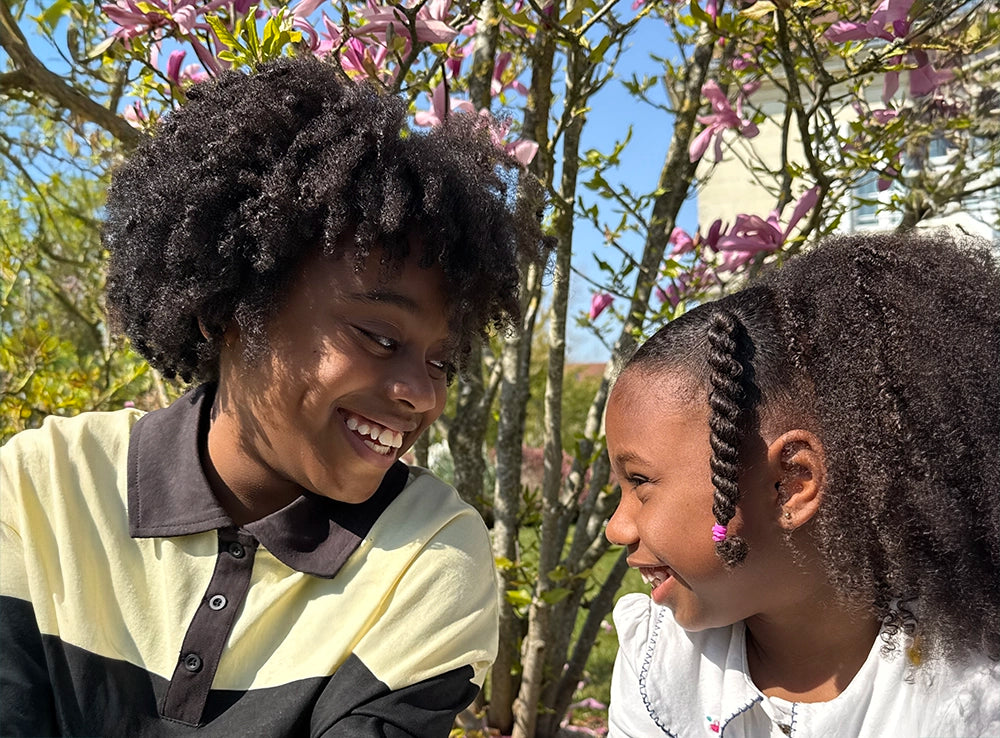
5 simple steps to care for children's afro-textured hair In the "nappy hair" family, the kids are joining in! Yes, they are entitled to their own hair routine too. It must not only be adapted to the needs of their curly hair, but it must also be simple and quick. Here are 5 steps to follow at home, for the benefit of both the little ones and the grown-ups. Caring for children's afro-textured hair: what are the specifics? You should know that a child's hair routine is never set in stone. The best approach is to modify it regularly to adapt it not only to their age, but also to their hair type. During the first months of their lives, your little ones don't have major hair requirements. Their hair is rarely damaged at this age and can make do with the bare minimum. However, as children grow older, their hair gains texture and thickness. This means that you will need to gradually increase the richness of the treatments. Children's hair routine: in what order? Overall, the order of applying products is the same for children as it is for adults. Depending on the thickness of your children's hair, you can make some slight variations to this routine. Perform this ritual every 3 to 4 days, with the exception of the leave-in, which should be used every day! Start by detangling the hair. Use a shampoo, then dry the hair. Apply a moisturizing leave-in. Seal with a balm or a cream. Proceed to styling. 1/ Detangling: the right moves A detangling session that ends in tears is not fun for anyone. To limit breakage (both literally and figuratively), teach your children to adopt the right habits from an early age. Always start detangling with a few sprays of detangling lotion. If you don't have any on hand, you can also quickly create an emulsion with water and a little vegetable butter. Distribute the product throughout the hair, then divide it into sections. Choose a wide-tooth comb to make the task easier. Never start detangling from the root; instead, start from the middle of the hair. Work your way down gradually to the ends without pulling too hard. Once you have detangled the bulk of it, switch back to a finer-toothed comb to perfect the result. 2/ Which shampoo should you choose for your children? Washing children's hair from 0 to 5 years old We have some good news for you: the shampoo step is purely optional at this age. Rinsing with warm water works perfectly. There is no need to compromise the hair's hydration if it is relatively clean. One less step is something everyone at home will appreciate! From time to time, you can try conditioner washing (or co-washing). This technique consists of using a conditioner instead of a shampoo to wash the hair. The whole point is to limit the use of surfactants to maximize the hair's natural moisture. Shampoo from age 5 Youngsters are much more active from the age of 5 and start to get their heads dirty regularly. You can therefore switch to a proper shampoo routine. Choose a sulfate-free moisturizing shampoo or one with very mild surfactants, like our must-have Hibiscus Solid Shampoo. Does your child play sports very often? Suggest they replace their regular shampoo with a clarifying shampoo once a month. This will help remove the final residue of sweat, dirt, sand, chlorinated water, sea salt, or other such things. 3/ Conditioner and/or leave-in The younger your little one is, the more we recommend prioritizing light formulas to hydrate their hair. Once again, stick to purely moisturizing care: their hair does not yet need to be repaired. The star product for this step: the Hibiscus Hair Milk leave-in. Over time, you can occasionally introduce a protein conditioner to maintain a good water/protein balance. The Coconut-Spirulina mask is perfectly suitable for use on children. 4/ Creams and balms to seal in moisture The thicker children's hair fiber becomes, the more hydration it needs to stay supple. The LOC or LCO method is therefore very interesting, except on hair that is too young and fine and has not yet reached its final texture. By layering too many products, you risk weighing down the hair and loosening the curls. So forget about vegetable oils for now. Instead, turn to a water-based cream to seal in the hydration provided by the leave-in. For this purpose, the Hibiscus Cream is a unanimous favorite, for both little ones and grown-ups. Later on, when your child is older, the Kalia Nature team recommends sealing with a richer treatment such as the Fondant Balm. 5/ And what about styling? For children, you absolutely must stick to light styling to avoid hindering hair growth. The idea is to limit hairstyles that cause significant tension in order to prevent alopecia. In this category, we find ponytails, buns, and, generally speaking, hairstyles that are pulled too tight at the hairline. Regardless of the hairstyle chosen, don't hesitate to rehydrate it during the day with a leave-in spray. As for the night, make sure your offspring goes to bed with a sufficiently loose hairstyle. You will thus spare them the phenomena of hair fiber breakage while they sleep. Braids and twists are very suitable, provided they are not too tight. Kalia Nature is for the whole family! Kalia Nature offers natural hair products for children and adults with textured hair. Want more tips for styling your children's curls... and maybe your own? Find Kalia Nature's expertise on Instagram.
Learn more